



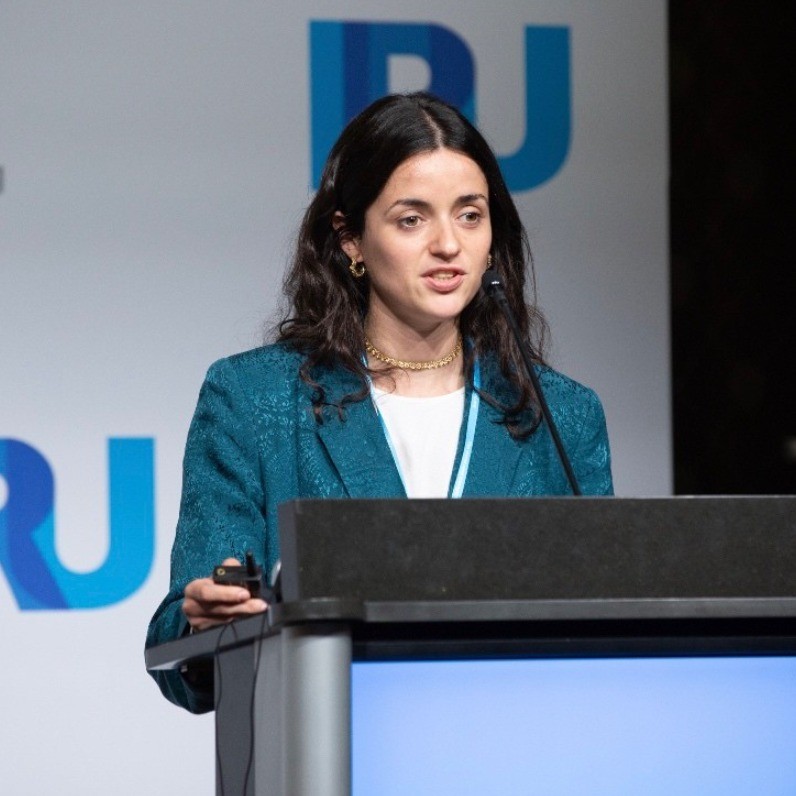
Self-introduction, history and interest in transportation and gender
I am a lawyer with extensive professional experience in the field of NGOs and human rights. It was around this time that I began to gain a deeper understanding and knowledge of global gender issues. I specialized in criminal law and have always had a keen interest in women’s rights, in particular, how penal codes across different jurisdictions protect women’s rights. I realized then how radically different women’s rights and conditions can be around the world, more even so at the cultural, social, economic and political levels.
I started working at IRU in 2023. The vision of the Women Driving Change Project is very much related to my background, although the road transport industry was new to me. There were a lot of challenges in this industry. One of the major challenges facing the industry is the driver shortage, which is an issue hitting at a larger or lower extent many countries. The Women Driving Change Project derived as a potential solution to this issue with the aim of increasing women’s participation and enhance working conditions for all drivers, supporting both employers and employees to do so
Current project - Women Driving Change Project
Launched in February 2024, the Women Driving Change Project responds to the persistent driver shortage by focusing on a single strategic objective: attract and retain women across the road transport sector. Women are markedly underrepresented in transport overall. And if you look at the trucking industry in particular, it’s not an exaggeration to say that the share of female drivers is precariously low and almost non-existent in many countries. We recognize that the issues we want to solve with this project are real issues that require long-term persistence.
From the outset the initiative followed a data-driven approach: we reviewed existing research on driver shortages, commissioned a dedicated study on women in road transport (with special attention to truck driving), and convened a global webinar series that brought together female leaders and entrepreneurs to share lived experience, barriers to entry, and practical attraction-and-retention measures. Those insights were synthesised and published in the IRU Women Driving Change Report, providing evidence-based recommendations and a roadmap for employers, policymakers and sector stakeholders — including IRU — to scale effective solutions over time.
A Charter for Women and Road Transport
IRU has developed practical, evidence-based measures and sector-specific best practices to help employers attract and retain more women in the road-transport workforce. This work originated with the EU Charter for Women in Road Transport and is now being scaled up into a consolidated Global Charter for Women and Road Transport.
While larger companies typically perform better on gender inclusion, the road-transport sector is dominated by small operators that often lack HR capacity, dedicated staff or budgets to run targeted recruitment drives. The Global Charter is explicitly designed to close that gap by offering straightforward, low-burden measures that reflect the real constraints of small businesses — for example, actions that require minimal staffing or modest investment.
Piloting the Charter revealed practical challenges: many very small firms still employ no women at all, and female truck drivers remain especially scarce, which made direct workplace feedback harder to obtain. To address this, IRU partnered closely with national associations and corporate members throughout the drafting process to refine the content and ensure it is relevant and implementable across markets.
Following a series of consultations and regular stakeholder calls, IRU produced a simplified Charter that sets out clear, core commitments for employers and makes adoption easy. To aid implementation, the organisation also developed a package of supporting materials that translate those commitments into concrete steps — including suggested actions, implementation checklists and, where feasible, indicative cost breakdowns to help small operators assess affordability and plan uptake.
Networking initiatives
Networking is a core pillar of the project: by building connections we amplify role models, reshape the public image of road transport, and make the sector’s career paths visible and credible to more women. The industry still projects a strongly male-dominated profile — sometimes in tangible ways, such as parking and rest facilities that do not meet women’s needs — and those practical barriers must be addressed alongside cultural change.
IRU is facilitating this shift by connecting companies across many countries, with a particular focus on very small operators that lack HR capacity or regular access to sectoral best practice. These networking activities — from targeted outreach and peer-to-peer exchanges to webinars, publications and direct calls — help companies understand concrete steps to attract women and to strengthen their employer brand. While the work explicitly targets women’s participation, the improvements it drives benefit the whole workforce.
Because most operators are small and can struggle to stay informed, organised knowledge-sharing is essential. Our collective approach keeps resources practical, easy to adopt and firmly grounded in the realities of small businesses; feedback to date has been positive, and we are committed to sustaining these networks and expanding participation.
Examples of effective practices
Many effective best practices cost little or nothing; they simply need to be shared and adapted to employers’ concerns and capacities. Much of our work involves helping companies—especially small ones—identify what they need and what measures are feasible.
A particularly effective practice for small employers with no women in their workforce is to hire two women simultaneously. This reduces isolation, helps them adapt to male-dominated environments, and significantly improves retention. We’ve seen women stay longer when they have a female peer from the start.
In Eastern Europe, hiring couples—either entering the business together or being employed jointly—is another successful approach that helps bring more women into the sector and supports retention.
The US has the highest share of women truck drivers, combining labour-market progress with strong industry initiatives, regulatory flexibility, and employer-led inclusion programs. The sector places particular emphasis on mentorship and training, as well as promoting trucking as a viable economic opportunity for women through effective cultural framing.
Trucks are not easy to operate, and their ergonomics are not designed for women. At the same time, practical barriers persist: many commercial vehicles and their equipment were designed around male anthropometry, creating genuine ergonomic and operational challenges for women (for example, cab access, control layout and tasks that involve lifting or handling heavy loads). Addressing these barriers requires both upfront transparency and equipment investment.
Two practical responses that are proving effective:
- Clear recruitment and role design — specify physical demands in job descriptions and recruitment materials so candidates understand requirements in advance and can self-assess suitability. Use gender-neutral language and emphasise available accommodations.
- Operational and equipment adaptations — invest in or provide access to powered handling aids (tail lifts, mechanised pallet movers, forklifts where appropriate), cab and control ergonomic adjustments, and vehicle procurement standards that prioritise inclusive design. Where full upgrades are costly, incremental measures (e.g., lift-assistance tools, revised loading procedures, or subcontracted handling support) can materially reduce barriers.
Combining transparent hiring practices with practical adaptations will lower entry barriers, improve retention, and broaden access to trucking for many more women.
Message to Japan
We had never included Japan in our research, and we had no connections in Japan. Women still face significant challenges in road transport. Unfortunately, legal restrictions still exist in many jurisdictions, their removal is a necessary — but not sufficient — condition for progress. The more persistent challenges are social and cultural: entrenched stereotypes, male-dominated workplace norms and behaviours, and an industry image that does not reflect inclusivity. These factors continue to shape both entry into and retention within the sector.
Addressing this requires a deliberate shift in workplace standards and employer practices. Basic but critical measures — such as ensuring appropriate facilities for all employees, including women — remain inconsistently implemented and signal broader issues around inclusivity. Improving the sector’s image must therefore go hand in hand with creating working environments that are safe, respectful and fit for a diverse workforce.
IRU places strong emphasis on these foundational changes: fostering inclusive workplace cultures, promoting gender-sensitive infrastructure, and encouraging employers to adopt practices that support both women and men equally. Initiatives such as this dialogue are valuable in building bridges across regions, sharing experiences, and accelerating progress toward a more inclusive road transport sector.