



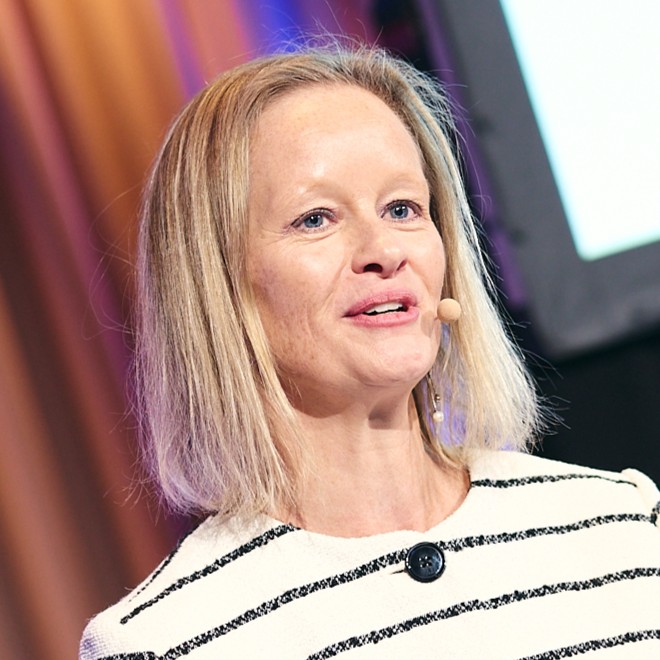
Self-introduction, background, and interest in transport and gender
I have served as Secretary General of POLIS—the network of cities and regions working on sustainable mobility and innovation—since 2014. Before that, I was POLIS’s Research Director, overseeing research, innovation activities, and projects, and prior to that I worked at Eurocities, also focusing on the transport sectorin cities. My first job in transport was at a non-profit mobility management center in Leuven, Belgium (then called “LangsanLangzaam Verkeer,” now “Mobile21”). We supported municipalities with mobility planning, education and awareness-raising, communication campaigns, and mobility activities for schools. Since 1998, I have also been involved in European projects and thus became deeply engaged with transport research themes at the European level.
Looking back, in my first European project there were only two women among 30–40 partners, including myself. It was clear that transport was a strongly male-dominated world, and at the time gender rarely even came up as a topic. Now, however, while the problem as such hasn’t been solved yet, I feel the situation awareness has changed significantly. In addition to the “workforce” perspective—that women’s participation in the transport sector is needed—there is growing recognition that gender must be mainstreamed into mobility planning and that transport systems cannot be truly inclusive unless women’s mobility needs are considered.
At the same time, I think we must be cautious because even well-intentioned discussions tend to drift toward narratives of “women = vulnerable.” Women’s safety and security are certainly important, and mobility needs can differ in certain contexts. However, we should not box women into stereotypes such as “caregivers for children and shoppers.” We make up more than half the population, and that fact alone is sufficient reason for our needs to be reflected in planning. I have been consistently concerned with moving away from a paradigm that defines women solely through “weakness.” or stereotypical roles.
Current projects
One of our key pillars at POLIS is the “Just Transition.” Since launching our Just Transition agenda in 2021, we have been discussing how to advance a paradigm shift in transport while ensuring that no one is left behind. This is not only about gender; it is about making the transport system more inclusive and ensuring that the transition is fair and equitable. Gender is one of its core elements.
We are determined not to leave this as a paper exercise, so we established a permanent Just Transition Task Force and are building practice and learning through activities such as a webinar series. One current focus is transport poverty, where women are disproportionately affected because their mobility needs are often insufficiently met. We emphasize intersectionality, viewing challenges as arising from multiple factors—race, culture, ability, age—intertwined with gender.
Role within the project
The Task Force is participated in by our member cities and regions (including associate members), and two of my colleagues serve as coordinators. We work to ensure that Just Transition is infused into all our other thematic working groups (active travel, new smart mobility services, urban freight, clean vehicles, governance, safety & security etc.). Concretely, we set up joint meetings between the Task Force and each working group, and we design collaborative activities to examine the themes I mentioned through the lens of gender and inclusion. It is not easy to keep this constantly on the agenda, but by creating spaces to genuinely explore synergies through joint activities, we make sure awareness stays high.
We also use our twice-yearly magazine, Cities in Motion, to maintain momentum by publishing special issues on priority themes—for example, one titled “Whose city is itA city for whom?” In addition, we place great importance on spaces for public–private dialogue. It is crucial to bridge tools and methods developed by research institutions and companies into forms that cities and regions can implement; in areas such as new mobility services, public–private collaboration is especially indispensable.
Project outcomes and evaluation
A tangible outcome is the change in gender-focused sessions at our conferences. When we first organized a gender session around 2016, the audience consisted of only three or four women. Even so, we believed it was important and continued, and for the first few years we also ensured that moderators across all sessions were women, as a way to signal the conference’s stance. Today, gender sessions are among those with the highest attendance, and achieving balance among speakers at events is easier than before. We have moved from an era when all-male panels were not questioned to one where ensuring appropriate representation of women is becoming the norm.
Another major result is the ripple effect of leading cities’ practices to other regions. We leverage exemplary cases from pioneering members such as Vienna, Lisbon, Catalonia, and Île-de-France, and spread their practices to other cities to inspire them. We document webinar outcomes as reports and place emphasis on continuously building a legacy.
On the tools side, we collaborated with the World Bank’s Sustainable Mobility for All initiative, with support from the FIA Foundation, to create a toolkit focused on workforce issues (including women’s participation in the transport sector). We collected actionable case studies not only for cities and regions but also for companies, and we use the toolkit as a springboard to advance gender mainstreaming. In our dialogues with companies, the need to visualize imbalances in usage patterns and user demographics (for example, overwhelmingly high shares of young male users in new mobility services) has been shared, and this has sparked awareness of gender mainstreaming on the industry side as well.
Moreover, I repeatedly emphasize the importance of sex-disaggregated data. Without data showing differences in mobility needs and highlighting realities that have not been considered, we cannot overcome blind spots. Good planning is built on data.
Future outlook
Going forward, while deepening the Just Transition discussions—including transport poverty—we aim for gender and inclusion perspectives to function as standard lenses within each thematic area, rather than as “special topics.” One important tool here is the SUMP (Sustainable Urban Mobility Plan). The SUMP guidelines position the consultation of diverse groups as a procedural requirement in plan-making; if we follow this, the voices of diverse stakeholders—including women—should be reflected. Once mechanisms for citizen participation and co-creation are in place, gender issues will inevitably surface and lead to better improvements.
Message to Japan
First, I want to commend the efforts to raise awareness on this theme and the launch of a website. Building on that, the keys are how the central government supports capacity-building for local authorities and how it facilitates exchange of experience among municipalities. Municipalities—closest to citizens—see directly the impact of policies on the ground. Start with data, learn from practices domestically and internationally, and create mechanisms that can scale and replicate successful initiatives. If European and Japanese cities can engage with each other, we can learn mutually across a wide range of urban mobility fields—not only gender.
Lastly, while we are seeing backlash around gender DEI globally, at least in European cities attention to diversity, equity, and inclusion is growing. Of course, we recognize that polarization and populism are also on the rise in Europe. We are not immune; we have learned, including in the context of transport poverty, that backlash can arise when people feel “excluded from the conversation” or “overlooked.” That is precisely why we want to design a transition that truly leaves no one behind, and build consensus step by step through data and dialogue.