



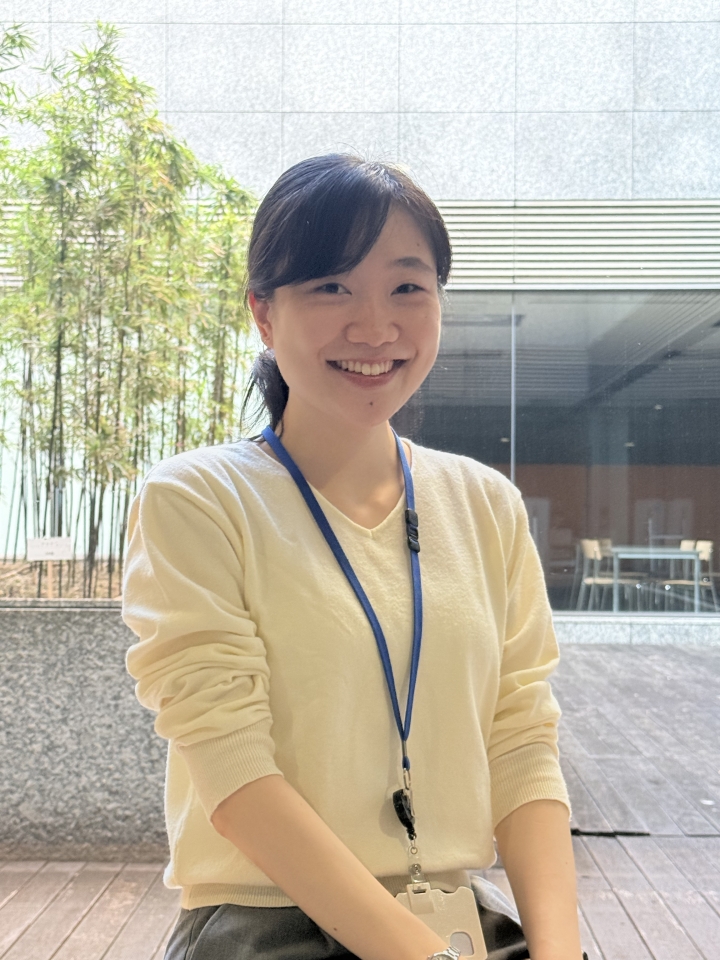
Self-introduction/ Interest in gender
Before joining the Ministry of Land, Infrastructure, Transport and Tourism (MLIT), I first became interested in gender while studying at an university in Australia. There, the words and concepts of gender were part of everyday life. For example, I would often see female bus drivers, and in public spaces there were posters and campaigns about ensuring safety from a gender perspective—public outreach from municipalities and government that I would encounter regularly. Gender perspectives also occasionally came up in conversations with my Australian friends at university. I recognized it as a concept that existed to a certain extent in local society, and I understood it as something you don’t really see in Japan.
Because of these student experiences, after I joined MLIT and was first assigned to the International Affairs Division, I learned that transport and gender were being discussed at international conferences. I came to understand that in many countries this exists as part of the government’s work—as policy—and I was convinced by that. At the same time, because it hadn’t yet taken shape as policy in Japan, I hoped we could somehow bring that perspective into Japan as well.
During my year and a half in the International Affairs Division, I believe we were in the dawn phase of MLIT engaging with gender—taking head-on, as concepts, the gender perspectives being discussed in international organizations, and putting them out to the public for the first time as MLIT. I was able to work on a gender perspective that had interested me to begin with, and even as we groped our way forward and struggled, I felt a sense of traction and my interest in gender deepened.
After that, I moved to the Railway Bureau, where I currently work on the future direction of JR and local railways and on tasks that change the very structures of society, such as legal revisions. From my position, I can catch glimpses of on-the-ground conditions in the railway sector, and I continue to cultivate my interest in gender and transport.
Projects/efforts to date
My work during the dawn phase for MLIT on gender in the International Affairs Division left a strong impression on me.
In the latter half of 2023, we discussed the mission of the International Affairs Division. Alongside promoting Japan’s high-quality infrastructure overseas—communicating Japan’s strengths—there was a policy trend toward “importing” overseas trends into Japan: collecting global trends in transport policy, introducing them domestically, and, if possible, providing information that could inform policymaking. I worked on organizing policy areas that are commonly seen overseas but not domestically, drawing on discussions in multilateral forums such as the ITF and G7. As a result, several keywords emerged: transport and AI, transport and health, and transport and gender. By listing these then-unfamiliar policy areas and conducting repeated brainstorming, we decided to pursue the field of gender and transport.
I think momentum around the gender-and-transport discussion gradually built. For my part, as a member of the International Affairs Division, I coordinated with various bureaus within the ministry. One memorable effort was working to newly add a gender-and-transport perspective to the Cabinet Office’s “Women’s Version of the Basic Policy” (Josei-ban Honebuto). At the time, many bureaus were understandably puzzled by an unfamiliar term, and I worked persistently to explain and gain understanding, struggling through the process.
Just then, when the G7 Transport Ministers’ Meeting was held in Milan, I traveled on a mission with the MLIT Minister and had the opportunity to attend the meeting. On that occasion, the Minister conveyed to the other G7 ministers that Japan would advance initiatives on the theme of gender and transport—specifically, to co-host a seminar with the ITF to introduce international discussions and to hold a panel discussion featuring executives from Japanese transport operators on realizing inclusive transport and promoting women’s participation in the transport sector. Personally, I felt that because the message came from a country that is relatively late in advancing women’s participation in society, it elicited a kind of surprise and interest from other countries. After that, I was actually involved in organizing the “Gender and Transport” seminar, which left a very strong impression on me.
Future outlook/message
As I noted at the outset, around the time before and after I joined MLIT I had opportunities to be exposed to overseas perspectives. I realized that the concept of gender is discussed internationally at the level of policy discourse, and that it has permeated to the point where you see gender perspectives in everyday public spaces—on the street and in local transport. This was both surprising and, in some ways, enviable to me, and I earnestly hope to see the same in Japan’s transport administration.
Currently, in working with railway stakeholders, I can glimpse the particularities and on-the-ground realities of the railway sector. I am still learning, and to be honest, I have not yet identified the methods or direction for translating gender into concrete policy. For example, in the International Affairs Division I saw overseas initiatives that incorporated gender perspectives—fare structures designed to avoid rush hours, rolling stock and timetables, and so on—but these are not measures that should be uniformly adopted in every country. Rather, I believe we must seek approaches suited to each country’s industry structure, needs, and culture. Meanwhile, Japan’s transport industry faces major challenges, such as labor shortages and securing local mobility. I hypothesize that incorporating gender perspectives could help address some aspects of these issues.
Going forward, I want to continue engaging with various industries across the MLIT portfolio and deepening my learning as an MLIT official. I hope to be able to work not only with gender as a normative concept, but also on efforts that incorporate it into concrete policy.