



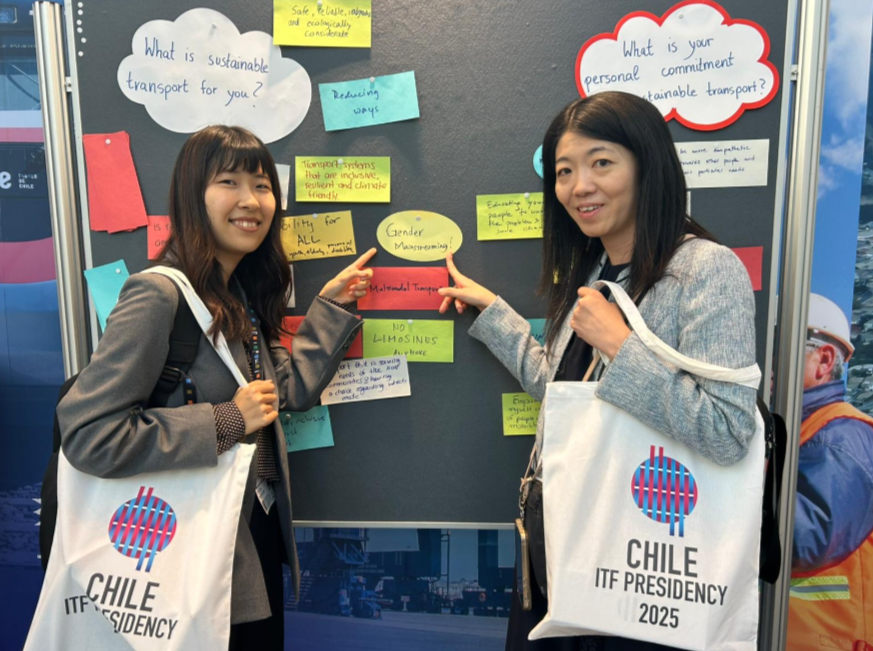
Self-introduction and interest in gender
I spent my student years at a girls’ school, and from my teens I was strongly aware that society must not be one where options are narrowed just because someone is a woman. That awareness led me to take a deep interest in what are commonly called gender issues.
At the same time, I was fortunate to grow up without being told “because you’re a girl,” and to live quite freely. As an individual, I feel I have experienced relatively little inconvenience specifically because I am a woman. You could say that, in some respects, I hadn’t fully made gender issues my own.
Against that backdrop, when I began thinking about gender through the lens of the land, infrastructure, transport and tourism field, and looked at concrete scenes of daily life one by one, I realized I actually had many difficulties: “When I fly, I want to put my bag in the overhead bin, but I’m short and not strong enough, so maybe I should give up,” or “When I walk at night and there aren’t many streetlights, it’s dark and scary,” and so on.
It was only by bringing a gender perspective into my own life that I could really feel these things. I have begun to realize firsthand that among what I had merely felt was inconvenient or had passed off as a personal issue, there are cases where differences arising from gender are at play.
What I worked on
When I was assigned to the International Policy Division of the Policy Bureau, the “Gender and Transport Seminar” had just been held on July 25, 2024. It was the moment when the very first step toward promoting gender mainstreaming was taken.
Compared with Europe and North America, the concept of “gender mainstreaming,” which means incorporating a gender perspective, has not yet taken root in Japan. Therefore, to continue communicating “what gender mainstreaming is” and “why gender mainstreaming matters in the land, infrastructure, transport and tourism field,” our division, under former Director-General for International Affairs Yuki Tanaka, continued gathering information by making use of every multilateral forum in which the International Policy Division is involved.
In the team I was assigned to at the time, we raised issues proactively on gender mainstreaming from MLIT at international meetings such as APEC, ASEAN, the OECD, and UNESCAP. In our relationship with the International Transport Forum (ITF), starting with the “Gender and Transport Seminar,” we collaborated on various related meetings.
I myself traveled overseas on mission—attending a side event on gender at the ministerial-level ITF Summit and presenting Japan’s efforts on gender mainstreaming at an ASEAN transport working group. By debating in international gatherings where many countries come together, I was able to feel firsthand the global current of discussions on gender mainstreaming, which I found extremely valuable.
Another major gain was that, once countries recognized that “Japan is interested in gender mainstreaming,” we could connect with the officials responsible for this work. We conducted individual online interviews with Sweden, Canada, and the United Kingdom, and heard how they actually translated gender mainstreaming into policy in ways suited to each country’s circumstances. The information was extremely useful in considering our future approach. Above all, I was deeply impressed by how passionately they spoke about gender mainstreaming, and I remember how reassuring it felt to know there are people around the world working earnestly on it.
As a move to feed the insights gained from international conferences back into our domestic work, we held an in-house “Roundtable by young and mid-career female staff toward gender mainstreaming” together with the Coexistence Society Policy Division. The ideas and opinions voiced candidly by young and mid-career women working across bureaus included many things that even I, as a woman, had never imagined. I felt it offered new discoveries not only for male staff but also for female staff.
Outlook
In recent years, we often hear the word “inclusive,” and the concept of a “coexistence society” that aims for a community where everyone—beyond just gender differences, including children, older people, persons with disabilities, and foreigners—can live vibrantly, has become widely accepted.
On the other hand, when gender equality is discussed, the difference between “equality” and “equity” often comes up. I have come to feel that, in addressing gender gaps, it is important to keep not only an “equality” perspective, but also an “equity” perspective. Beyond a macro view of diversity, we need to consciously recognize latent differences—like gender gaps—that have historically been overlooked.
One example that greatly surprised me when I began studying gender mainstreaming was automobile crash tests. Caroline Criado Perez’s Invisible Women: Exposing Data Bias in a World Designed for Men points out that, for many years, the crash-test dummy was based on the average adult male’s physique, and that because women’s data was not sufficiently taken into account, an “injury severity gap” arose in which women were more likely to be injured in car accidents. Crash tests are conducted to confirm safety for everyone, but if experimenters are not aware of differences such as those between male and female body types, gaps like this can remain unaddressed.
Gender is easily misunderstood as something that singles out “women,” but as with crash tests, experiments are now conducted using dummies that reflect not only male but also female and child physiques, improving safety for all people, not just women.
In Japan’s public spaces and socioeconomic life, there are quite a few situations in which men and women face different challenges and needs. In the MLIT field, for example, it is said that “women carrying children or luggage experience many inconveniences when walking or using public transport,” and that “women, who are more likely to be targets of harassment or violence in public spaces, often feel unsafe.” Gender mainstreaming focuses on these differing issues for men and women, responds carefully to each set of needs, and seeks to design and implement all policies and projects accordingly.
Because MLIT’s work is deeply connected with people’s everyday lives and society, I would be delighted if our efforts help society share the idea that by incorporating a gender perspective that has unconsciously been omitted until now, things will become easier to live with for everyone—not only men and women, but also children, older adults, and persons with disabilities. Both personally and as an MLIT official, I intend to keep thinking about this.