



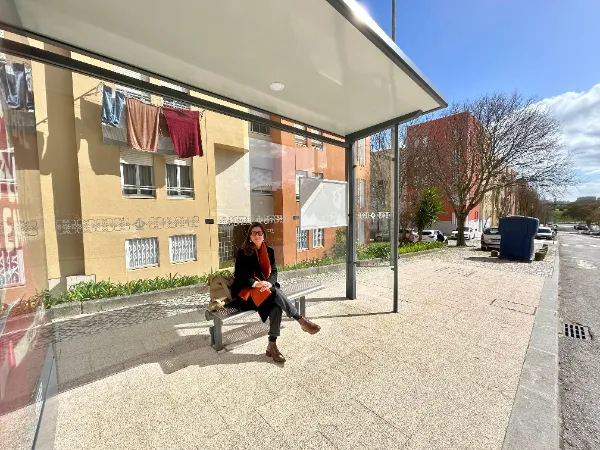
Self-introduction, background, and interest in transport and gender
I work at the Lisbon City Council on a team dedicated to pedestrian accessibility. I have been at the Council for a little over nine years, always with the Pedestrian Accessibility Plan. My academic background is in ergonomics, and I studied human factors for inclusive design and urban studies —how to observe and research people who tend to be excluded in urban environments, and how to adapt environments and infrastructure to include them better. This has been useful for addressing gender issues, because it equips me with trained perspectives and methods for inclusion, observation, and policy action.
I previously lived in London, UK, where I worked at a local housing association alongside my research and was involved in research regarding housing and rights for people with disabilities.
My interest in gender did not start necessarily as “gender studies.” While looking at people in public spaces and the exclusion of people with disabilities from those spaces, I realized that in the same city and in the same places, women and girls were not using public space and public transport in the same way, sometimes feeling fearful or excluded—and that this had long been overlooked as “normal.” When something has always been there, people accept it as a matter of course. If you want to change something that has persisted for decades—within an organization or across society—changing how people think is always difficult. My background has had a major impact on my work and, I believe, has been very useful.
Current projects
One of Lisbon City Council goals is to reduce the number of cars entering the city and shift the mobility model away from private car ownership, addressing issues related to carbon footprint, sustainable mobility and public space management within the city. Safe, comfortable pedestrian infrastructure that makes people want to walk and use public transport is essential. This is where a gender perspective is also needed.
Role within the project
Our team currently has 12 members. When we started working on this topic, we were a group of three from our team, together with a Masters and PhD student that collaborated at different moments with us along the way, as well as other two Lisbon professionals interested in this area. My role spans from programme strategy, survey design, on-the-ground dialogue, and inter-organizational coordination. Specifically, to gather information on the experiences of women and girls in Lisbon, our team conducted interviews with various groups of women, for instance, focus groups with women with and without children, university students, women with disabilities, and LGBT women. We also had an online survey for students living and/or studying in Lisbon.
Later on, for our pilot project at Bairro Padre Cruz promoting the safety of women in public spaces and access to public transport, during our Data Collection & Diagnosis phase we gathered more information, this time for a specific neighbourhood. We created our own methodological framework and chose the key issues that we wanted to address, such as accessibility, convenience, sexual harassment, social dynamics, and personal safety. We conducted a survey with around 110 teenagers at the local school, we conducted more focus groups with girls and women with a variety of mobility patterns, from the neighbourhood (50 women in total), and we interviewed women at local bus stops. Using large maps of the neighbourhood, we asked participants to identify areas/streets/bus stops where they felt concerns related to road safety, sexual harassment, personal safety, amongst others. We asked them to elaborate on their feelings and reasons for their perception of certain areas, either positive or negative. Because this is a sensitive topic, we first explained to all local organisations—local borough, neighborhood associations, youth groups, residents’ association—that we wanted to study this theme, and we proceeded by meeting all entities face to face, emphasizing the importance of having their cooperation. We also adopted a policy that focus groups collecting information from women and girls would be facilitated by women, prioritizing a sense of safety.
At a later stage, we presented and discussed our data collection results and diagnosis with local associations, and discussed which challenges should be prioritised for improvement and the exact locations to tackle, either through street re-design or by relocating bus stops. We held various meetings and negotiation with the Lisbon bus company CARRIS (a municipal company which operates independently with its administration and budget), as this would imply changes in bus routes and re-location of one bus terminal. It was important to explain and emphasize the importance of promoting the safety of women when accessing public transport, and highlight this is a valid reason for considering bus stops relocation.
Project outcomes and evaluation
Construction is currently underway and is expected to be completed within three months. Works involve the re-design of some streets with traffic calming measures, improvements for pedestrian accessibility, and changes for six bus stops: two new stops, two stops relocated and two stops being adapted. We hope this will bring benefits for everyone. When we started our project, the local main street, which has foot traffic and clusters of everyday activities such as the market, post office and the cultural center didn’t have any bus stop. We changed bus stop locations with this in mind, from the standpoints of both convenience and a sense of safety.
There are clear lessons learned. Because the process has taken so long, we should have communicated better with local residents. Even if massive work is progressing behind the scenes—design, securing financing, permits, adjustments to street lighting and underground infrastructure—residents may feel, “We gave our time, but nothing is happening.” To avoid losing trust, especially from those who have helped a great deal with their time and emotional sharing, we need to improve how we communicate progress.
Right before the construction works phase initiated, we carried out a second phase of on-street surveys in order to have a ’‘before and after intervention’’ evaluation and compare answers to the same questions before and after the works. We interviewed women and girls, and conducted the survey from 6 a.m. to midnight. There is a risk that perceptions may not change as much as we would hope for after completion, but we will wait for the results, accept them as they are and carry out a post-project evaluation that includes not only the measures themselves but also strategy and communication. It is not an easy topic to work on, and there is some backlash at times. Hearing from many different women, with different opinions, is a key lesson I take from this experience.
Future outlook
Our next task—and strategy—is to ensure this does not end as a pilot limited to one district. More than simply expanding to other boroughs, it would be stellar if the City Council could incorporate these challenges and recommendations as part of its work when developing urban planning proposals, changes to public spaces or mobility strategies.
Rather than our team waving the flag and saying, “Think about this; don’t forget it,” we would like to see it as an everyday priority. Beyond that, I see mobility not only as part of a climate deal and equality strategies, but as a core element of care and proximity policies in the city. One reason mobility is not gender-neutral is that, in reality, women carry much of the care work—shopping, child-rearing, elder care, community activities. We want to make the city a place where everyone can do these things safely and comfortably, regardless of gender. We also want to create an environment where the next generation of children are not imprinted with the idea that “girls can’t go home alone at night.”
Message to Japan
I recommend not starting with a large-scale plan, but beginning at a small to medium scale: meet people first, listen, gather solid on-the-ground data, show that you are serious about this and know what you are talking about, and learn as you expand. If the words ’‘sexual harassment’’ or “gender” itself carry too-strong a stigma for a particular group or culture, it can be effective to adapt the language to your audience. Our experience tells us that teenagers are much better prepared to speak frankly about this and that with older women it may be better to begin talking about “discomfort” and ’‘fear’’ in public space. Language grows within the conversation.
We learnt a lot while doing this project. Rather than pretending everything is perfect, I want us to keep moving forward while sharing what didn’t go well, too. We have a lot to improve.